

Housing has Australia’s attention
With the federal election looming large, the pressure to design better housing policies and deliver them at pace, is only going to intensify. From this timber merchant’s point of view, there is no doubt legislative stimulation is required but it will only receive the necessary focus if our governments are able to drag themselves away from their self-interested finger pointing and empty promises. Charter Hall’s CEO, David Harrison, suggests, “It’ll end up getting to a breaking point where the politics will get removed because people don’t have accommodation, or can’t afford it.” Amen to that!
As noted by the Australian Financial Review, host of the AFR’s Property Summit in early September:
“Australia’s housing woes are seeping through the economy, causing policymakers, investors and households to make decisions they might not ordinarily make. Housing is eating the economy in countless ways. It’s visible in the way that banks’ loan and deposit books have become bifurcated (split) between those with property and money to spend, and the younger, less well-off households battling mortgage stress and declining savings. It’s visible in rising costs and weakening profits, as workers push for hefty pay deals to offset higher housing costs, and industrial relations become more fraught. It’s visible in Australia’s increasingly polarised political debate … “
The diplomatic posturing in Spring Street and Canberra are not the only reason our politicians are at the epicentre of this modern day emergency. The three standout problems being experienced by the industry are all linked to our law makers: taxation, construction labour and the wide ranging increases in the costs of building. Let me touch on items two and three, first.
“The three standout problems being experienced by the industry are all linked to our law makers”
Why has the price of building in Victoria risen at such a rate? At the top of my list is our state’s infrastructure program, one of the largest in our nation’s history, pushing up raw material costs at the worst possible time. Apart from the inflated rates of heavy building products it is the availability and cost of sub-contractors that is a leading point of frustration revealed to me through recent conversations with builders, big and small. As noted by the Property Council of Australia CEO Mike Zorbas, in the AFR on the 13th September, “a sixth of Victorian construction workers were on projects associated with the state government’s Big Build program.”
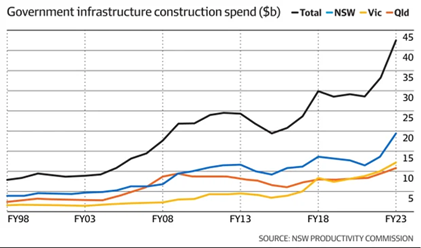
Despite the fall in house building activity, the issues associated with sourcing labour have eased little. The massive hike in worker’s rates have not retracted in line with slowing site starts; very few builders are expecting to see a change in the near to medium term.
The question remains, what can be done? Time and again, the obvious answer is there for us all to see. A greater share of overseas migrants trained in the trades we need: electricians, painters, plasterers, roofers, carpenters, bricklayers and plumbers. A few, simple adjustments to our migration policy can make it happen. As reported by Tom Dusevic in The Australian on 21 September, the NSW Productivity and Equality Commission set out a reform road map to support homebuilding in that state. Among its recommendations was a shift in migration settings to support the construction industry. Over the past decade, only 6 per cent of 700,000 skilled migrants had construction skills.
“Governments should shift the overseas migration intake to support construction and grow the local construction workforce,” the report said, noting a NSW shortfall of 30,000 construction workers to deliver the National Housing Accord. “Overseas construction qualifications should be better recognised in the visa process, migrants should be able to quickly put their skills to work and barriers to interstate mobility should be better addressed.”
A year ago The Age reported, “Victoria’s building and construction industry generated 333,165 full-time and part-time jobs … representing a drop of 21,078 workers – or 6.3 per cent – from May 2023.” The CFMEU has a different mind. Union national secretary Zach Smith said data had been twisted to show Australia needed more overseas labour. “(It is) bulls**t that is designed to hurt Australian workers.” [news.com.au, 6th June, 2024]
Of course, the cost and availability of ‘tradies’ has not been the only issue weighing down the home building industry. Taxation is front and centre. Where do I start? The industry’s taxation gripes could fill this newsletter many times over. Carolyn Viney, the former chief executive of Grocon, claims taxes and other charges now account for as much as 40 per cent of the cost of a new home.
And don’t forget the strain being placed on the working public’s access to what they earn. Between 2021 and 2024 household tax as a share of nominal income has risen from 17.5 per cent to 22.5 per cent, the highest it has ever been (Source: ABS, Macrobond, Westpac Economics). Hard to understand at a time when the cost of living in Australia has placed so many families under significant stress.
So, where is the positive vibe I like to espouse in my bi-monthly contemplations?
Despite the struggles outlined above, I am seeing (small) signs Victoria is beginning to give us cause to be optimistic. In the main, building companies have right sized, stripping out staff and unnecessary expenses. The costs associated with building have mostly stabilised (albeit, at a higher level) and build times are returning to where they were in 2019. Our politicians can frank the momentum and take all the credit, if they are willing to be brave.
“Despite the struggles outlined above, I am seeing (small) signs Victoria is beginning to give us cause to be optimistic.”
Bowens Benefits
A loyalty account that gets you 5% off every shop
Ready to sign up?
Already have an account?
Login hereTrade Account
Custom pricing, 30-day trade credit + more
Ready to apply?
Already have an account?
Login here