

Large Timber Post and Beam Warnings
Timber Post Risks & Mitigation
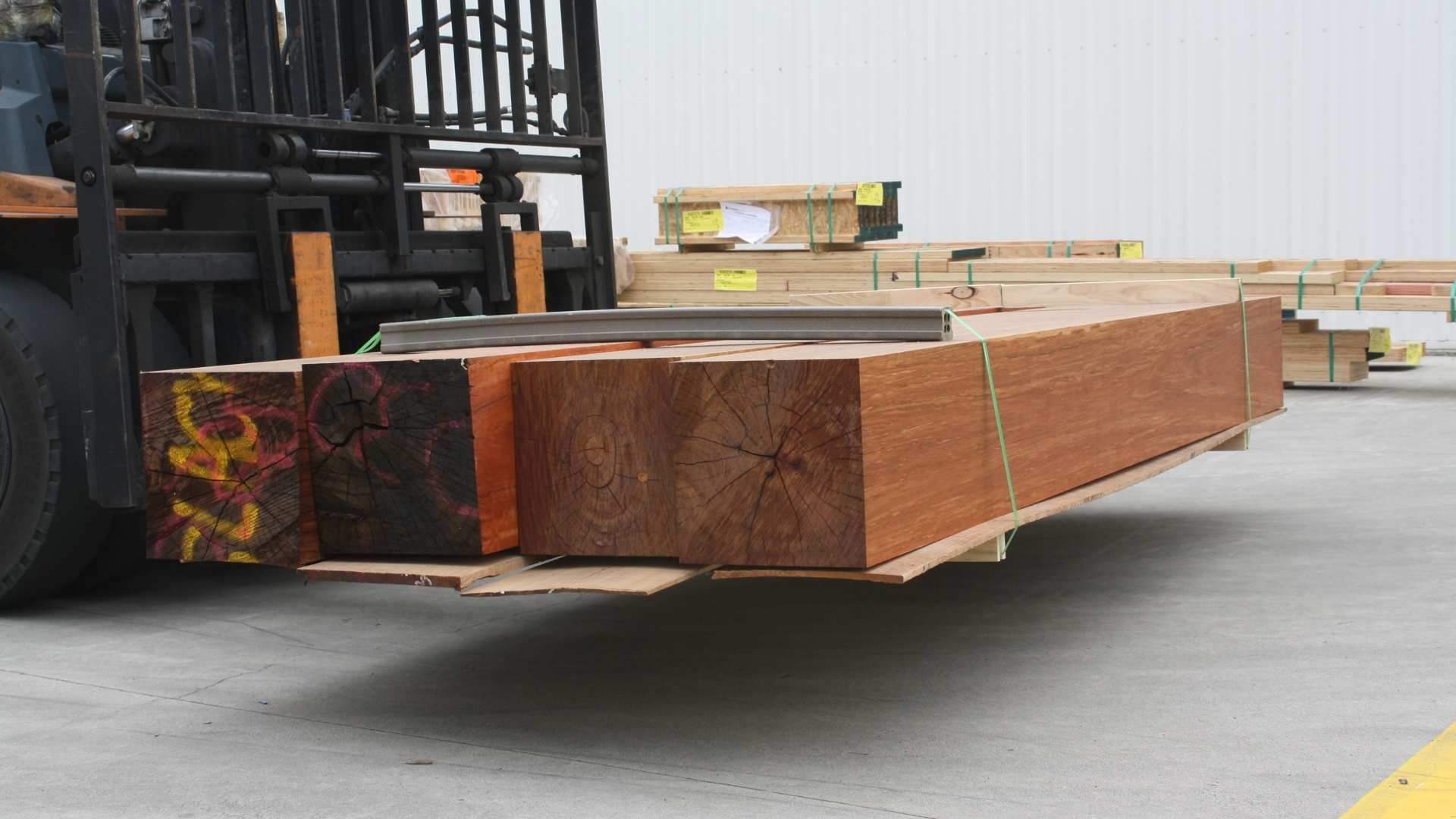
Recently, we have had some issues with large hardwood timber posts. The issues concerned excessive cracking and tannin staining, particularly over concrete.
At this point, it should be acknowledged that the resource available today to supply this type of product is sourced from secondary or regrowth trees. This means the resultant wood is not as mature as it was in previous eras when old-growth trees were harvested. Today, all old growth is locked up and not available for harvesting.
Today, the normal and cheapest procedure is to use a green offsaw sound boxed heart product, usually in a durable species. Consideration then should be given if the intended post is used in-ground or above ground on a stirrup. Accordingly, species selection should also be carefully considered, as some species have a greater propensity to crack than others. For example, Spotted Gum and Ironbark are less likely to crack excessively than Blackbutt and, to a lesser extent, Tallowwood. Having said that, keep in mind the product is unseasoned, so some cracking/checking should be anticipated, no matter what species is employed. Also, if the unseasoned product is subject to positioning in a north/west position, it can cause cracking more than other positions in the hotter months.
As far as tannin bleed is concerned, all species will likely bleed, particularly in an unseasoned form. As above, some species will tend to bleed more than others. From experience, the lighter-coloured species tend to bleed more than the darker species. For example, Blackbutt and Tallowwood bleed more than Spotted Gum or Ironbark. Ideally, some time should be allowed between supply and installation. This should allow some excessive bleeding to flash off a little. However, this scenario is usually not practical, and the product is required for immediate installation.
Accordingly, I suggest a general coating of an oil-based product like Cutek, then apply a sealing agent to the end grain (both ends), hopefully reducing moisture loss, cracking and tannin staining. The above considerations become particularly relevant when the intended product is used around concrete areas.
It should be acknowledged that green offsaw sound boxed heart is the cheapest way to go, and it could be that your budget only allows this type of product to be used. It would be prudent to talk to your client about the possibilities of cracking and, if relevant, tannin bleed. I suggest that you talk to us about your circumstances. I would be happy for you to contact me directly on 0412 550 740.
Alternatives
- While recycled timber is a favourite of mine, it should be acknowledged it will likely cost at least twice as much as the equivalent species above, unseasoned product. Why? The recycled product would have been insitu for some time, so it is likely seasoned to a degree where cracking will be greatly reduced. Also, the material could have come from an era where the wood is better than today’s regrowth wood. Finally, it should be noted that sometimes your preferred product may not be available in recycled form.
- There are quite a few laminated products on the market, in hardwood and softwood treated products. Keep in mind the softwood products will not have a high strength rating. The advantage here is the laminations are kiln-dried, so the product is relatively stable.
- I have just learnt about the wrap-around concept, where you select your nominated species, which is wrapped around perhaps a cheap structural graded timber core. The problem I perceive is keeping the wrapped-around species stable (being out in the weather). Accordingly, I would give wrapped products multiple coatings of an oil-based product like Cutek, hoping to stabilise the wrapped members. It is a very interesting concept. Externally, I have some concerns. Internally, the concept has appeal.
- I would seriously consider, as mentioned above, applying an appropriate agent to the end grain of any product used in an external post-and-beam situation. Why? Because most moisture gain/loss is mainly via the end grain, and if you can minimise moisture movement, you have a more stable product, as well as reducing tannin bleeding.
- For posts in an in-ground situation, apply a bitumen paint to the part that goes in the ground. Why? Endeavouring to waterproof the post from moisture and avoid rot.
Bowens Benefits
A loyalty account that gets you 5% off every shop
Ready to sign up?
Already have an account?
Login hereTrade Account
Custom pricing, 30-day trade credit + more
Ready to apply?
Already have an account?
Login here