

Understanding the Timber Resource of Today
Sapwood and Heartwood
A recent experience prompted me to write this article. Perhaps we, as a responsible industry, have not done enough to explain how environmental pressures have affected the resources available to us today.
So, what do I mean by the resource of today? In simple terms, it means the size of the tree our products derive from. These trees are called regrowth trees and are relatively small, compared to past eras when the resource was larger, older growth trees. That’s where we need to understand some Basic Wood Technology. In explaining this, we should understand that a tree is a living thing.
The Sapwood is the outer ring of the tree that contains its food and receives moisture from its roots, and as such, the cells are open.
The sapwood is not durable and, in many species like Spotted Gum, is susceptible to borer attack. However, because the cells are open, most reputable producers have it treated so it is immune from borer/ fungis attack.
Again, because the cells are open, it’s more subject to changes in moisture content than the more durable heartwood.
The Heartwood is the dense, central wood of a tree trunk. When a tree reaches a certain age, it decides it has enough sapwood/food to survive going forward and is full of extractives. This causes a change in the cell structure, leaving the tree more durable (resisting / fungis attack) and stronger so it can’t be blown over in strong winds. However, because the cells are clogged, treatment is minimal or not possible.
Because the cells are clogged up with extractives, it’s less susceptible to moisture content changes than the sapwood.
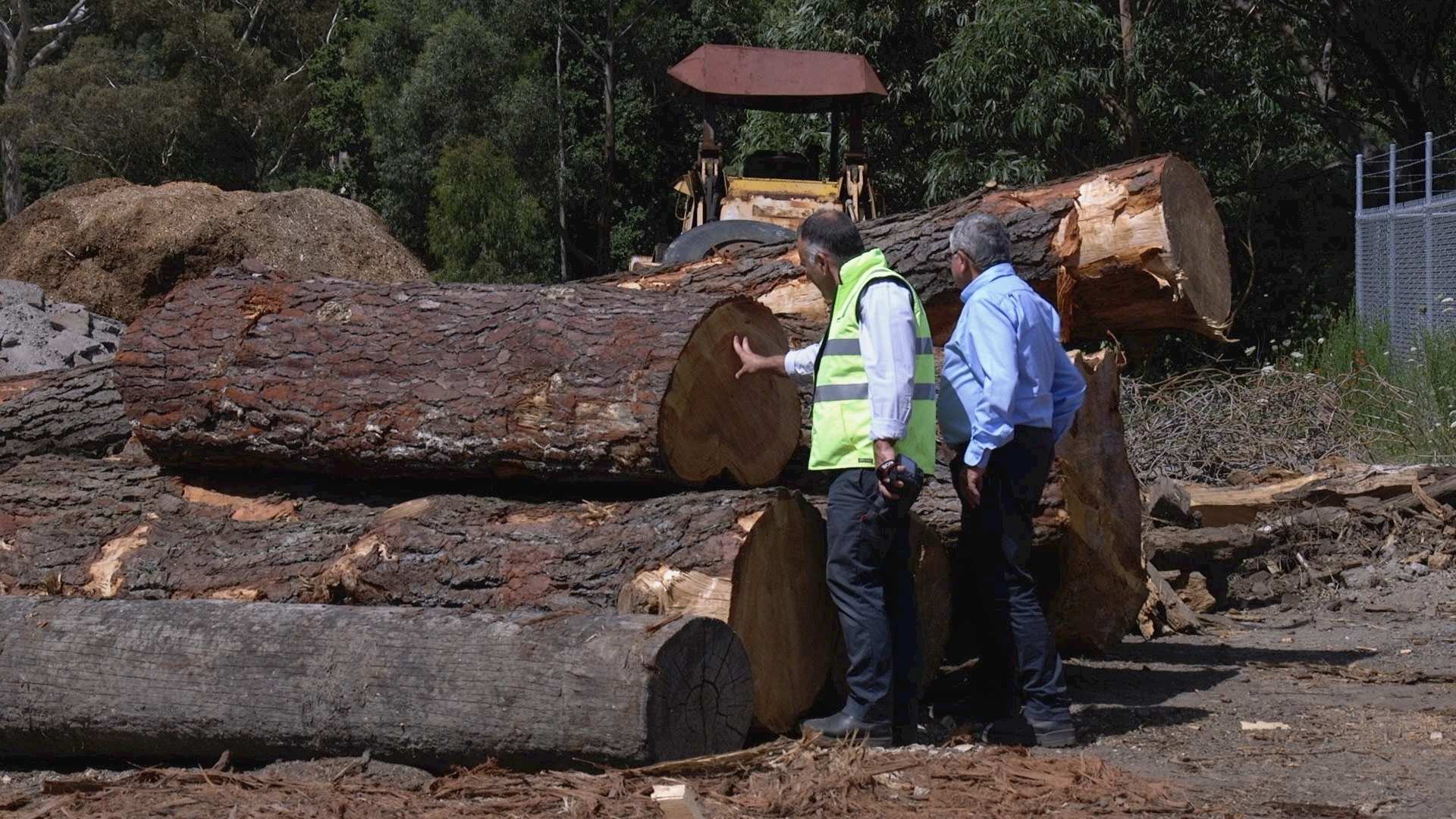
The Annual Growth Rings are layers of wood added to the tree’s trunk every year, and when studied, can indicate the tree’s age, climate history and environmental events.
With the smaller regrowth trees, these rings will always show them horizontally across the board’s width. This means board movement will be more likely than if the rings are mainly vertical. For this to happen, larger trees are required, such as the trees used for Tasmanian Oak flooring. Also, larger trees like Tasmanian Oak allow the producer to exclude the sapwood in the production process, whereas with the smaller regrowth trees, producers cannot exclude the sapwood to maximise production.
In conclusion, timber produced from smaller regrowth trees coming from NSW, Queensland and WA is often likely to include the Sapwood and horizontal rings. Consequently, they are likely to be more reactive to moisture content changes and are less stable and durable than in the past.
Accordingly, my suggestion is to always have your decking and cladding oil-coated to prevent moisture uptake as much as possible, resulting in more stability and durability.
Now to the case I mentioned: 50mm Blackbutt boards were used as flooring on a wide, mid-platform staircase situation, exposed to west-facing windows. For the reasons above, this caused excessive shrinkage. In this case, I’d have recommended acclimatising the boards for as long as possible before installation to reduce the movement in the floorboards.
So, builders and specifiers beware of the above when using species such as Spotted Gum, Blackbutt and Ironbark, usually derived from small regrowth trees, particularly in internal and decking situations.
Finally, to you, our valued customers, I am always available for free advice, but keep in mind that it is given based on suggestions only; others may have a different point of view.
Bowens Benefits
A loyalty account that gets you 5% off every shop
Ready to sign up?
Already have an account?
Login hereTrade Account
Custom pricing, 30-day trade credit + more
Ready to apply?
Already have an account?
Login here