

Expert Timber Advice: Preventing Post-Installation Problems
Avoid these Timber Issues
Some will remember that in my last Builders Bulletin article for 2025, I committed to offering free advice for customers on the use of most timber products. I say this having experienced so many issues over many years of troubleshooting for Bowens, where post-installation problems have resulted in costly repairs.
Accordingly, I am writing this article to reaffirm that commitment and do so by further stating that prevention is a much better course of action than a costly cure or repair.
Already at this early stage of the new year, I’m pleased to report I have received a call from a Phillip Island client seeking advice on the re-coating of his deck.
It is our intention to, wherever possible, keep our valued clients free of post-installation issues. To help achieve this mission, I list some of the timber products or problems I often encounter and can offer assistance with.
- From experience, I have found that most post-installation problems occurred when the wrong product was used and/or poor installation methods were employed
- Accordingly, ask yourself, is your product fit for purpose? I have a formula that can suggest the appropriate product
- We can offer suggested installation guidelines for products where there is a history of post-installation problems
- Advice on the use of large timbers, particularly when durability is important
- Advice on the installation of in-ground timber posts, including *treated pine and cypress pine
- The use of oil coatings and why they assist in achieving board stability
- Understanding the treatment of wood and the various hazard levels available
- The importance of ventilation and how to achieve this important prerequisite for a stable floor or timber deck
- Advice on the use of recycled timber products
- The regulations on retaining walls, particularly when above 1 metre in height
- Advice on products available for use on a retaining wall.
*The 90×90 treated pine posts have two shades of green. The dark green is the preferred sapwood, where the cells are open and will accept the treatment solution. However, the light green is largely an untreatable heartwood. Here, the cells are clogged with various substances, which therefore won’t allow penetration of the treatment solution. These cells serve the dual purpose of naturally making the original tree more durable and stronger so as to withstand strong winds.
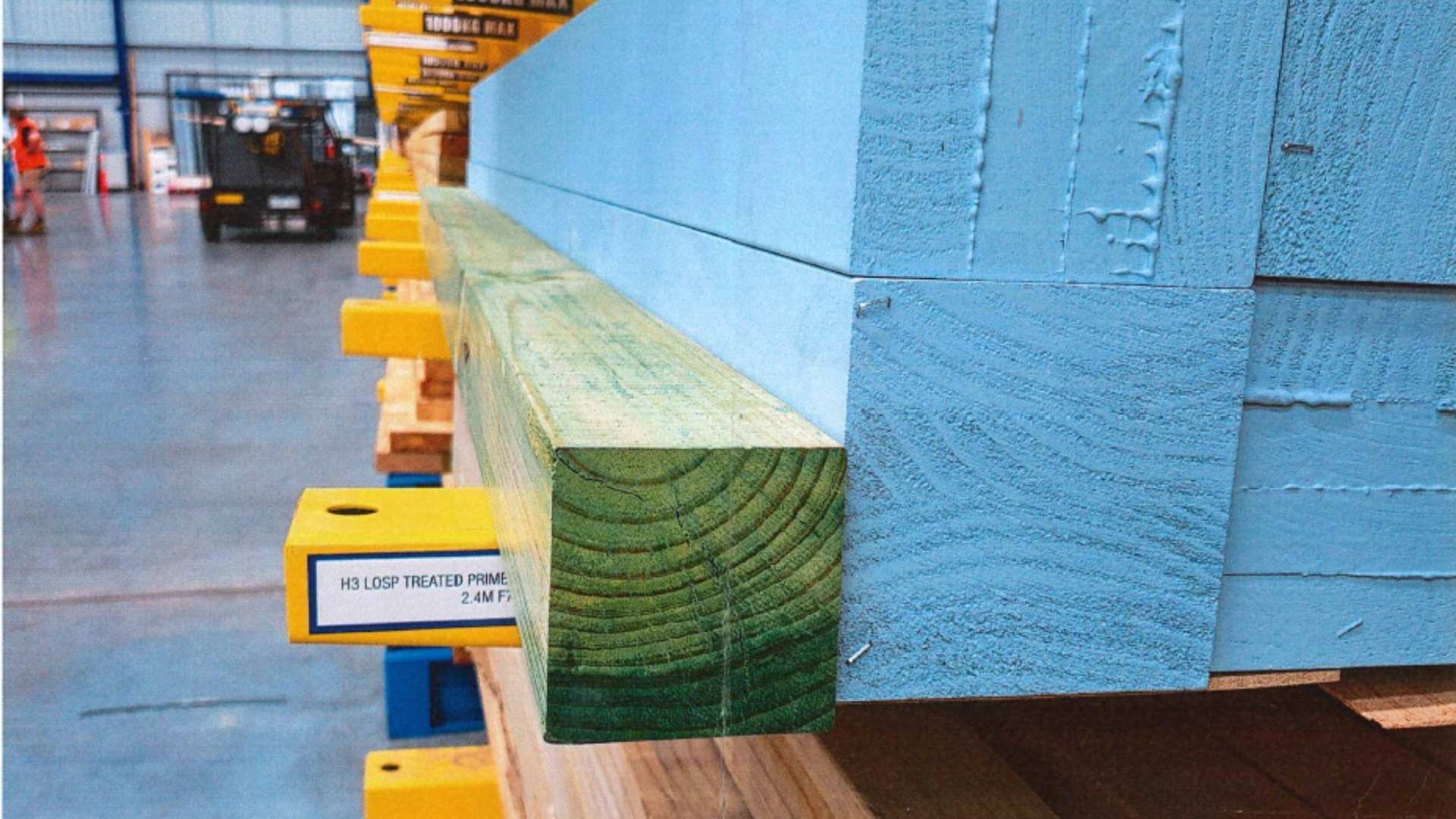
The photo shows far too much light green (untreatable heartwood). Accordingly, the user should then inspect the other end to see if it displays a deeper green. If so, that is the end that should go in the ground.
In the case of naturally grown cypress pine, the sapwood is never durable, so when used, we would hope the sapwood is kept to a minimum, and the durable heartwood is present.
With cypress, there is usually a colour difference between the non-durable sapwood and durable heartwood. The sapwood is light brown, and the heartwood is dark brown; some would liken it to Hawthorn colours.
Accordingly, the user should look at each end and place in the ground the end with the darkest brown or heartwood.
I list the above examples to illustrate that we have the expertise to advise people on how timber products can be successfully used. As stated above, I’m available to advise on such issues on 0412 550 740.
Bowens Benefits
A loyalty account that gets you 5% off every shop
Ready to sign up?
Already have an account?
Login hereTrade Account
Custom pricing, 30-day trade credit + more
Ready to apply?
Already have an account?
Login here