

Understanding Humidity and Maintaining Board Stability
Mastering Humidity for Stable Surfaces
Most of us are familiar with the detrimental effects that bushfires, especially during low humidity periods in the dry summer season, can have on our surroundings. Unchecked low humidity also poses a significant threat to timber floors, often resulting in irreparable gaps between boards.
“Unchecked low humidity also poses a significant threat to timber floors, often resulting in irreparable gaps between boards.”
Contrary to common belief, high temperatures are not the sole culprit. Let me illustrate why I make this claim. Many households today have standard reverse-cycle air conditioners, operating on refrigerated cooling. While these units cool the microclimate EMC within the dwelling, they also extract humidity from the atmosphere. Prolonged use of such air conditioners can lead to unwanted board shrinkage. On the flip side, if the air conditioner is based on evaporative cooling, it adds humidity to the microclimate EMC, potentially causing board expansion and, in severe cases, structural damage to the dwelling.
There are exceptions, such as direct sunlight through windows causing flooring shrinkage or the warmth from a heater in winter inducing shrinkage in front of the appliance.
“(…) direct sunlight through windows causing flooring shrinkage or the warmth from a heater in winter inducing shrinkage in front of the appliance.”
My Suggestions
As the holiday season approaches, I once again caution against locking up houses, creating a hotbox scenario that may leave timber floors in a distressed state upon return. Consider the following precautions:
- Leave some windows slightly open to allow the dwelling to breathe.
- Have a close neighbour regularly open the house in your absence.
- Set your air conditioner to come on for specific periods during your absence.
- Draw window drapes when exposed to sunlight.
These suggestions primarily address flooring situations, while the following recommendations pertain to decking scenarios.
Contrary to common belief, ventilation between decking boards only occurs when there is allowance made between base boards. Mechanical ventilation may be necessary in cases where this is not feasible. For a healthy, long-lasting deck, consider the following steps:
- Ensure there are sufficient gaps between the decking boards to prevent sub-deck humidity buildup.
- Use mechanical ventilation if straightforward ventilation is challenging (such as the perimeter of a swimming pool).
- Allow sufficient gaps between boards for normal expansion/shrinkage.
- Apply moisture protection over deck joists to prevent excessive moisture content.
- Ensure proper deck drainage.
These recommendations for both flooring and decking aim to prevent problems arising from low or high humidity. Bowens provides more detailed installation guidelines for both products, which we are happy to advise on.
“Bowens provides more detailed installation guidelines for both products, which we are happy to advise on.”
A key thing to remember is wood is hygroscopic. My dictionary defines hygroscopic as; absorbing/loosing moisture from the air. The meter often used to obtain equilibrium moisture content (EMC) is called a hygroscope that measures humidity.
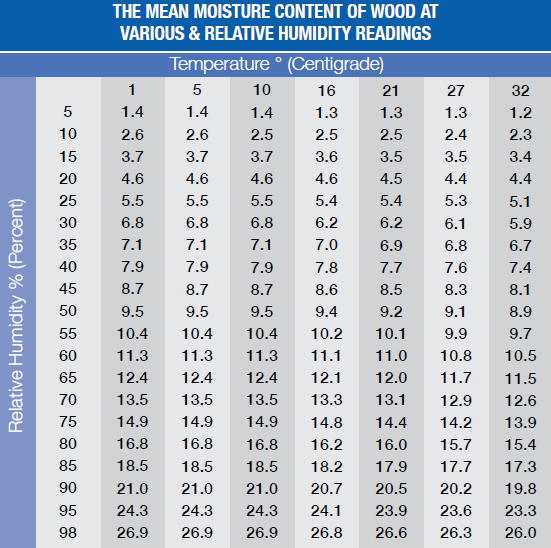
I have attached a chart that shows both humidity and temperature variations. You will note the governing factor is humidity, the temperature has little impact on the EMC.
Below is a chart illustrating humidity and temperature variations. Note that humidity (not temperature) is the governing factor for EMC. As a point of interest, the average all-year EMC for Melbourne is approximately 11%, influencing the moisture content of your floor or deck.
Bowens Benefits
A loyalty account that gets you 5% off every shop
Ready to sign up?
Already have an account?
Login hereTrade Account
Custom pricing, 30-day trade credit + more
Ready to apply?
Already have an account?
Login here