

Understanding Timber: The St Kilda Pier Project
Choosing the Right Timber Matters
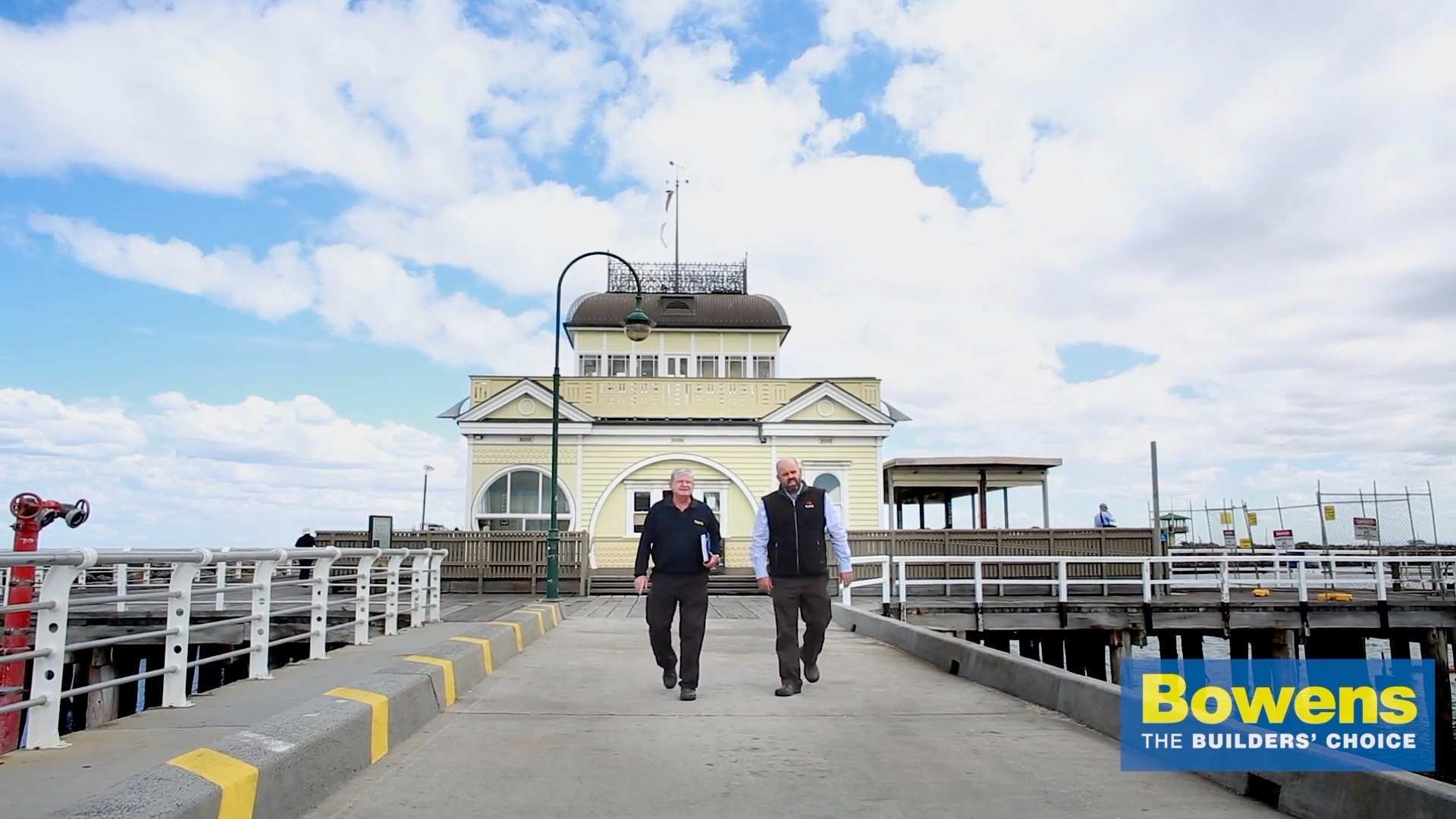
I always have believed the products I supplied to the heritage listed St Kilda Pier Kiosk in 2004 were probably the best selection I ever made given the project’s notoriety, and the harsh marine conditions involved. The original kiosk was built in the early 1900s but was destroyed by arson in 2003. Due to massive public response and with the then-Premier, Steve Bracks, it was decided to rebuild the kiosk exactly to the original 1903 plans.
Request for Original Materials
Parks Victoria, the project managers, awarded the contract to McCorkell Constructions, a long-established Bowens client. Howard McCorkell contacted me to supply the timber products (excluding joinery items). This included wood machining and specialised shaped rafters for the top floor of the structure. Parks Victoria, unrealistically, insisted the timbers were also to be as originally supplied. Accordingly, when it came to product selection (as we do with any special job) we had to take into consideration the harsh marine conditions, particularly the external claddings, they would have to endure.
Sourcing Materials
One of the materials that could be duplicated was Oregon beams used for long floor joists (about eight metres) and the curved roof rafters. The only problem was the specification requested the Oregon to be dry. I sourced some reasonably dry Oregon from an Adelaide miller I knew and the Oregon for the flagpole from a miller in Geelong. Fortunately, McCorkell’s had some oldish timber we could use for the curved rafters. The framing and subfloor timbers had to be a class 1 hardwood, so we supplied 120×35 Blackbutt sourced from Boral Timber.
However, the claddings presented my greatest challenge, particularly the wide teardrop profile. Accordingly, I sourced some Ironbark from a recycler, probably, the best in Australia. They produced for me a finished dressed size of 290×17, produced from 300×75 Ironbark floor joists originally from a school built in 1889. When I received the material, I was in awe of how a wide thin section each board seven metres in length could be so straight and stable.
The other cladding was a 200-millimetre-wide square edge, similar to the standard stock profile. The cheapest option to produce would have been to diagonally cut two ex 200×38, however this would have exposed too many different internal moisture gradients for board stability. Instead, I opted to produce from 200×25 kiln dried select Spotted Gum, even then taking two separate machine passes to achieve board stability and the right taper.
Machining, Shaping & Profiling
When it came to machining, shaping and profiling, I engaged a master wood machinist Tom Russo (Peninsula Wood Machining) to handle all curved rafters, tear drop and square edge weatherboards.
Remember these products were supplied over 20 years ago, so if you are visiting the St Kilda Pier Precinct take a walk to the end of the pier and have a look at the above claddings. I reckon if they are still in situ they will be there for another 100 years.
So, why am I writing about timber we supplied so long ago? Perhaps because I have seen so many problem jobs over the years, particularly when not enough time was spent on product selection.
Bowens Benefits
A loyalty account that gets you 5% off every shop
Ready to sign up?
Already have an account?
Login hereTrade Account
Custom pricing, 30-day trade credit + more
Ready to apply?
Already have an account?
Login here